
 Share
Share
 Tweet
Tweet

Learning to read in the early years enquiry: Park Primary School, Dumfries and Galloway
The Learning to Read in the Early Years programme and the associated professional learning resource provides an in-depth, research-informed opportunity for schools and ELC settings to strengthen early reading practice. The programme supports participants to connect research with classroom and setting practice through videos, reflective activities, professional dialogue and collaborative learning. Delivered to trios of practitioners and leaders within schools or settings, the programme culminates in a small-scale enquiry project tailored to local priorities and learner needs.
Enquiry focus
Our focus was developing a love of reading amongst our youngest learners.
We identified learners were not self-motivated to engage with texts in our settings. Parental engagement opportunities were also limited.
Park Primary School in Stranraer has a roll of around 260 children, a further 80 are registered to attend the Early Learning and Childcare setting attached to the school.
The school serves a catchment area which includes an area of high deprivation. 56% of pupils fall within SIMD deciles 1 and 2 and the remaining 44% within deciles 3 and 4.
Interventions are having a year-on-year impact on attainment in literacy, with 70% of children attaining expected levels in primary 1. Trends across the school suggest further intervention work is needed, with literacy attainment around 70% in primary 4 and 60% in primary 7.
Staff involved were:
- Rhona Gibson (P1/2 teacher)
- Diane Lowe (Nursery Manager)
By February 2025, 75% of our families will have engaged with parental engagement opportunities specifically linked to reading.
Measures included parental engagement trackers, parental and learner feedback, attendance records, book sign out/in sheets, book reviews and our observations of learners engagement with texts in our setting.
We made a number of small changes to practice. These included:
- stay and play sessions, Book Bug Sessions, development of a lending library, story votes, parental literacy drops ins and use of the TLQ (Talking, Listening and Questioning) intervention
- our focus was on sessions where our parents could come along such as stay and play and Book Bug. We changed our sessions to small groups to allow for a more relaxed environment for parents to feel more comfortable to attend

We observed both children and families enjoying sessions. This was backed up by the feedback shared and attendance levels at sessions. Feedback also told us that parents felt more enthusiastic about reading to their child.
We also observed that children were engaging with texts in reading based activities as part of child initiated play.
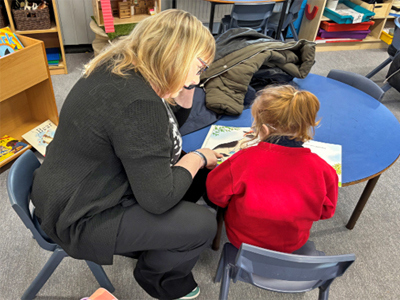
Parental engagement has soared with over 75% engaging in sessions or the resources provided. Children are independently choosing to engage with texts through their play.
We measured impact using whole school parental engagement trackers, feedback from parents and children and our observations.
We realised some children have no access to texts at home and the importance of providing these opportunities for families.
As practitioners, we role modelled how to read with children.
Small group sessions over a longer period of time were very time consuming however they were more beneficial to get key messages across and build relationships with parents.
We now recognise how small changes and adaptations to settings can have a huge impact on children and families.
How has the learning from the initial programme been taken further by you or your colleagues in your ongoing practice? How have you shared the learning with others?
We have continued with our lending library and stay and read sessions in P1 and ELC. P1 now also have a lending library and ELC also have stay and read sessions.
As part of our School Improvement Plan, we aim is to role this out to P2 and P3.
We shared our learning at a regional level, explaining the programme to others who are now involved and sharing our successes and challenges.
Parental involvement levels have been sustained and positive feedback has been received. Children continue to engage with books/ texts in their play and talk about reading at home.
Share this resource: